I've just had a wonderful holiday in Sri Lanka. It's a beautiful country, with much to see and enjoy, the culture and history, and not least the fabulous weather.
But not all is good in Sri Lanka - literally "beautiful island". The gulf between the rich and the poor is all too apparent. Here is a group of tea pickers who cheerfully posed for us in one of the tea plantations. These ladies were so friendly and cheerful, and yet they are amongst the poorest paid workers in the island. And their work is hard and back breaking, with the constant risk of bites from dangerous snakes.
Why am I telling you this story?
Because this week is National Ethical Investment Week.
Are there any similar things going on in the USA I wonder, as this particular initiative seems to be just for the UK?
But this should not matter - wherever you live, please read on…
Because our money gives us “spending power.”
It has been said that we cast a vote three times every day, by what we choose to eat and drink. By choosing how we spend our money, we can influence how shops stock their shelves, what goods are manufactured, the conditions in which they are manufactured. Our money can be a very powerful influence in all manner of ways that can affect our environment either directly or indirectly, for good or evil, when we have money available to spend.
Supermarkets will justify their actions in stocking inappropriate products that we know to be environmentally unfriendly, or harmful in some other way, with the excuse that they are simply giving us what as consumers we demand. If we buy them they will continue to stock them. It really is that simple!
Are our spending patterns encouraging animal cruelty or slave labor in garment “sweat shops”or in the tea plantations?
Appalling working conditions, child labor and poor pay still exist and we could be encouraging these without even realizing it.
The most effective and immediate impact we can all make could be through changing our spending patterns. We are all in control of how we save, invest and spend, whether we choose ethical products, buy fairtrade and traidcraft products, or perhaps give generously to aid agencies where we can be sure our money provides rapid relief.
We can and must fight to bring ethical trading in from the bottom up. We can enquire where our goods are produced and in what conditions and avoid all unreasonably cheap goods where we suspect that unethical working practices are present. If the information is not available, demand it.
We should support local enterprise. The local farmers markets promote respect for land and food. We could pay more for quality and eat less. Why not get back in touch with the seasons and eat foods at the right time of year when they are available locally. I am aware of the controversies over air miles versus the need to support foreign enterprise to help other communities; many of these stories must be considered on their own merits. Some of these choices may seem more expensive. But are they when balanced against the alternative predictions for our world?
Does the suffering of fellow beings and the future of our planet matter so little to us that we are not prepared to change our habits today?
Many of us own company stock, some of us perhaps without even knowing it, or at least thinking about it, because it is out of sight in our pension funds (although the turmoil on world financial markets at the end of the first decade of the new millennium, and the ongoing deep recession have brought such funds sharply into focus for many).
Businesses know that they must now be more accountable for their green credentials. But what about those companies that still operate unethical work practices. Those holding pension funds delegate full powers of investment to the fund managers who will be motivated and driven by the need to maximize profits and growth for the funds in their charge. As major shareholders these funds have enormous powers and are not likely to consider the ethical views of the individual pensioners against the overall drive for growth. It may seem that the individual does not have a voice. But we can have our say; we can influence others. All it needs is knowledge and courage and the support of other like - minded people. It can be done. Have you ever questioned your pension fund managers on this?
Does the small shareholder really know or even care how the company operates as long as he receives his regular dividend income? Can he possibly understand the full implications of the company’s business, how it treats its employees, how it deals with its waste, how it invests its own money. So many shareholders make their investments motivated solely by profit, without any regard for the ethical considerations. This is no less true of buying shares than buying consumer goods.
The implications of all this are enormous. As individuals we may unwittingly be helping to fuel warfare, for example, by carelessly investing or allowing our pension funds or banks or investment funds or unit trusts to invest in any company involved along the way with the production of weapons.
I pray for there to be a shift in attitude. When I was in practice as a Chartered Accountant and Independent Financial Adviser I had a particular interest in ethical investment funds for my clients. One bank without my knowledge or consultation transferred the ethical funds of one of my most principled clients into its own funds, declaring in the process that they would never take ethical considerations into account in their investment choices, only investment performance. This was some time ago. I hope the bank has reviewed its policies. Individuals who would think of themselves as ethical and feel aghast at the mess we are in have had their conscience swayed by the profit promise in this way. Have you checked the ethics of your own bank? There is plenty of information now available to check this out. Do you care?
Even the employees of a company who individually may think of themselves as honest and decent can be remote from the realities of the company’s business and the adverse environmental or social effects it may be initiating in its drive to make profits.
Do you know what your employer really does? Not just at the superficial level of your daily employment, but at grass roots? Are you absolutely comfortable with the company’s trading practices, its markets and its environmental footprint? And if not, what are you doing about it?
These are not comfortable questions. They challenge us. But with privilege comes responsibility, and there cannot be sustainable peace for all until injustices are tackled across the world. So let's look again with a critical eye at how we spend our money.
Adapted from an idea that is explored in some more depth in Healing this Wounded Earth: with Compassion, Spirit and the Power of Hope.
© Eleanor Stoneham 2012
"The penalty good men pay for indifference to public affairs is to be ruled by evil men." attributed to Plato
"Bad men need nothing more to compass their ends, than that good men should look on and do nothing." attributed to Edmund Burke
Monday, 15 October 2012
Friday, 28 September 2012
J K Rowling's own Shades of Grey
Do women lack the confidence to make their points of view known in meetings and radio phone-ins? It would seem so. Driving over to see my sister yesterday there was a piece on the radio, describing this imbalance between male and female voices where opinions are sought - something like 70% male to 30% females. And it seems much of this is down to a lack of confidence in the fairer sex. Why? Because we are afraid we have nothing important to say; that we will be ridiculed; that we will not be given a fair hearing.
I confess -
I have suffered from this to some extent all my life, around the meal table, in meetings, at conferences! Victorian children were "seen and not heard." It is only relatively recently that children have all been encouraged to be opinionated and their comments heard and indeed respected for what they are worth.
Now I feel I must voice my own strong opinion on something. Many will not agree but I don't care. This has to be said.
J. K. Rowling is worth upward of £500 million, much of her fortune reaped from the pocket money and birthday money of our youngsters. So why, hot on the heels of the Fifty Shades trilogy, does she feel the need to produce her own version of something much darker than the Harry Potter books knew how to be. (1) My concern is that I am sure this book, The Casual Vacancy, will be bought by those same youngsters and young adults who were introduced to reading by Harry Potter and his friends.One million have been pre-ordered already.
OK, we writers have a creative urge - many of us feel compelled to write. I understand that. But to write stuff which in places is frankly disgusting, disturbing, brutal, and unnecessarily explicit, in bad ways? Don't writers have some kind of social responsibility, especially where our young people are concerned?
I'm not a prude. But we are not going to become better people by reading books such as these. Rather we need to celebrate the beautiful and the wonderful ways of our world.
Why is this important? Because, as well as our inherited physical characteristics, it is widely believed that we pick up mental wounds from the collective experiences of our ancestors.
The unhealed wounds of mankind inflicted through millennia of evolution by strife and violence and disaster mean therefore that hundreds of millions of people are psychologically, emotionally and physically scarred and wounded and in need of healing. It has even been suggested by some psychologists that “human culture as a whole has been saturated by unhealed wounding, which, if unchecked, will continue on a downward spiral toward inevitable disintegration.” (2)
Surely we should be doing all we can to heal wounds, not perpetuate them? How can we hope to heal the world when so many of us have such mental and spiritual wounds? And books like Fifty Shades of Grey and The Casual Vacancy simply do not help the quest to heal an already overly evil world.
Come on Jo. I hear that you give plenty of your dosh to good charitable causes. Perhaps you should be diverting your creative writing energies into something altogether more healing.
But then I put this forward diffidently with little confidence and I don't suppose any one will agree. I await the ridicule with trepidation.
Adapted from an idea that is explored in some more depth in Healing this Wounded Earth: with Compassion, Spirit and the Power of Hope.
© Eleanor Stoneham 2012
(1) see the Daily Telegraph September 27 2012 - "Oh Jo, What will the children think?" Re J K Rowling's latest book, The Casual Vacancy, Comment by Allison Pearson who writes - and I quote: "J K Rowling's first adult novel is an everyday story of country folk who beat their wives, are addicted to drugs and abuse their toddlers. It is a departure that will shock many fans."
I have read enough to know I won't want to read the whole book.
(2) Thompson, Judith and James O’Dea, Shift Issue 7, May 2005, “Social Healing for a Fractured World; a Summary Report to the Fetzer Institute.”
The picture is of Victoria Lilies at the Oxford Botanical Gardens.
I have suffered from this to some extent all my life, around the meal table, in meetings, at conferences! Victorian children were "seen and not heard." It is only relatively recently that children have all been encouraged to be opinionated and their comments heard and indeed respected for what they are worth.
Now I feel I must voice my own strong opinion on something. Many will not agree but I don't care. This has to be said.
J. K. Rowling is worth upward of £500 million, much of her fortune reaped from the pocket money and birthday money of our youngsters. So why, hot on the heels of the Fifty Shades trilogy, does she feel the need to produce her own version of something much darker than the Harry Potter books knew how to be. (1) My concern is that I am sure this book, The Casual Vacancy, will be bought by those same youngsters and young adults who were introduced to reading by Harry Potter and his friends.One million have been pre-ordered already.
OK, we writers have a creative urge - many of us feel compelled to write. I understand that. But to write stuff which in places is frankly disgusting, disturbing, brutal, and unnecessarily explicit, in bad ways? Don't writers have some kind of social responsibility, especially where our young people are concerned?
I'm not a prude. But we are not going to become better people by reading books such as these. Rather we need to celebrate the beautiful and the wonderful ways of our world.
Why is this important? Because, as well as our inherited physical characteristics, it is widely believed that we pick up mental wounds from the collective experiences of our ancestors.
The unhealed wounds of mankind inflicted through millennia of evolution by strife and violence and disaster mean therefore that hundreds of millions of people are psychologically, emotionally and physically scarred and wounded and in need of healing. It has even been suggested by some psychologists that “human culture as a whole has been saturated by unhealed wounding, which, if unchecked, will continue on a downward spiral toward inevitable disintegration.” (2)
Surely we should be doing all we can to heal wounds, not perpetuate them? How can we hope to heal the world when so many of us have such mental and spiritual wounds? And books like Fifty Shades of Grey and The Casual Vacancy simply do not help the quest to heal an already overly evil world.
Come on Jo. I hear that you give plenty of your dosh to good charitable causes. Perhaps you should be diverting your creative writing energies into something altogether more healing.
But then I put this forward diffidently with little confidence and I don't suppose any one will agree. I await the ridicule with trepidation.
Adapted from an idea that is explored in some more depth in Healing this Wounded Earth: with Compassion, Spirit and the Power of Hope.
© Eleanor Stoneham 2012
(1) see the Daily Telegraph September 27 2012 - "Oh Jo, What will the children think?" Re J K Rowling's latest book, The Casual Vacancy, Comment by Allison Pearson who writes - and I quote: "J K Rowling's first adult novel is an everyday story of country folk who beat their wives, are addicted to drugs and abuse their toddlers. It is a departure that will shock many fans."
I have read enough to know I won't want to read the whole book.
(2) Thompson, Judith and James O’Dea, Shift Issue 7, May 2005, “Social Healing for a Fractured World; a Summary Report to the Fetzer Institute.”
The picture is of Victoria Lilies at the Oxford Botanical Gardens.
Subscribe to:
Posts (Atom)
It's Time you knew - by Transition Rachel at YouTube
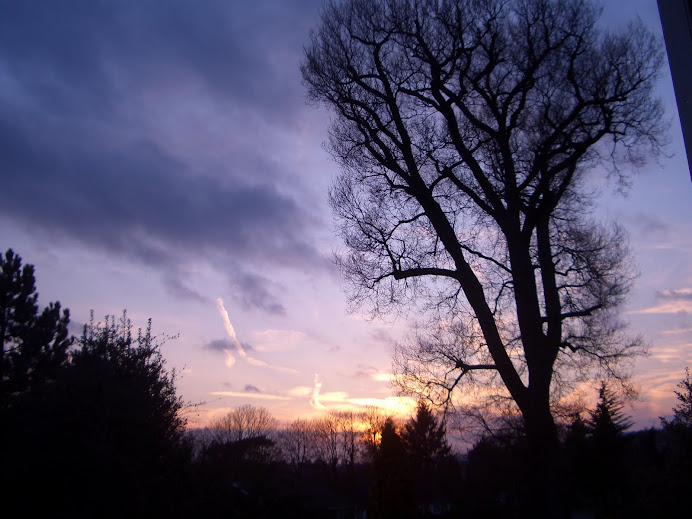
Sunset
with vapor trails