The Greek Philosopher and scientist Aristotle explained in his Politics in c 330BC why money had been invented. The art of acquisition, he said, for which a currency was required, arose out of the simpler barter of goods, and he saw this as quite natural and healthy. But when ‘The supply of men’s needs came to depend on more foreign sources, as men began to import for themselves what they lacked, and to export what they had in superabundance: …in this way the use of a money currency was inevitably instituted,’he wrote.
But Aristotle made the distinction, between essential and therefore laudable expenditure for the daily needs of food, shelter and clothing, and the acquisition of money for acquisition’s sake by profit associated with retail trade. The latter he censured,
"because the gain in which it results is not naturally made, but is made at the expense of other men. The trade of the petty usurer is hated with most reason: it makes a profit from currency itself, instead of making it from the process which currency was meant to serve. Currency came into existence merely as a means of exchange; usury tries to make it increase."
Aristotle did not trust money because he could see that it could feed an insatiable desire way beyond what was necessary for our needs and he saw this as unethical.
In addition to life’s basic survival necessities of warmth, clean air, medicine, clean water, food and housing, all human beings worldwide have a need and a human right to be free, to be respected as equals, able to choose their own destiny and to fulfill their full emotional, intellectual and spiritual potential. We are all entitled to the five basic human justices, of monetary and social justice, economic and environmental justice and of the right to peace.
I believe that to really achieve such justice in our world we need to allow the healing qualities of compassion and vulnerability and spirituality to infuse our lives and our actions in our financial housekeeping.
In later posts I shall reflect further on this and on where and why our present economy is flawed. Meanwhile Rediscovering Values, by Jim Wallis, is a good place to start reading. (also mentioned in a previous blog).
© 2010 Eleanor Stoneham
Showing posts with label peace. Show all posts
Showing posts with label peace. Show all posts
Sunday, 20 March 2011


Saturday, 11 December 2010
Truth and Tolerance - Pope Benedict XVI

The 7th century Irish robed Christ, wrought from Irish Turf, is taken from the 7th century bronze bookcover or plaque in the National Museum Dublin. Made by Owen Crafts Ireland.
You will note that I have been really busy reading books lately. Well for one thing there is very little one can do in the garden or at the allotment when they are both under a foot or more of snow, and there is a limit as to how much walking I can do in any one day. So here I am curled up in my warm study reading and writing.
Here is a scholarly book, quite a contrast to those I have read lately. But I persevered with it and have found it a most rewarding read. It is a compilation of lectures delivered mainly between 1992 and 2002 by Joseph Cardinal Ratzinger, now Pope Benedict XVI, on faith, religion, culture, truth and tolerance. He has brought them together in the context of exploring how religions can “relate to one another peacefully” and contribute to educating man towards peace, an urgent goal for the world today.
That is why I bought the book, as a contribution to my own current studies on how religions, mysticisms and spirituality can come together to find tolerance and peace in a world desperately seeking solutions for the mess we have made of it.
An important contemporary thinker of huge experience, this is a scholarly book but it is written in a lucid style and logical order that makes it also accessible for the intelligent reader who wishes to explore these vitally important religious, philosophical and theological issues in some depth. I found this an extremely useful contribution to this debate and have written a full review for Amazon.com and Amazon.co.uk
Tuesday, 7 December 2010
Second Sunday of Advent

Last Sunday in the morning parish Eucharist we lit the second of the four advent candles on our wreath. This candle is the Candle of Peace, standing for the Old Testament prophets and the peace we look forward to in the light of the Jesus Christ whose birth we eagerly await.
And we had that lovely reading from the prophet Isaiah 11 vv. 1-10 foretelling the coming of Christ, the shoot coming out of the stock of Jesse, and a branch growing out of its roots, "righteousness shall be the belt around his waist, and faithfulness the belt around his loins," and
6 The wolf will live with the lamb,
the leopard will lie down with the goat,
the calf and the lion and the yearling together;
and a little child will lead them.
7 The cow will feed with the bear,
their young will lie down together,
and the lion will eat straw like the ox.
8 The infant will play near the cobra’s den,
the young child will put its hand into the viper’s nest.
9 They will neither harm nor destroy
on all my holy mountain,
for the earth will be filled with the knowledge of the LORD
as the waters cover the sea.
For a detailed commentary follow this link, supplied by Anathea Portier-Young for the Luther Seminary: "The visions of 11:1-10 are characterized by a remarkable dynamism that is at the same time the mark and guarantee of stability and peace. In the visions, the order of nature, political and social life, and the common life of humans and animals are organically linked and woven together."
Sunday, 21 November 2010


Thursday, 5 August 2010

Subscribe to:
Posts (Atom)
Sunset
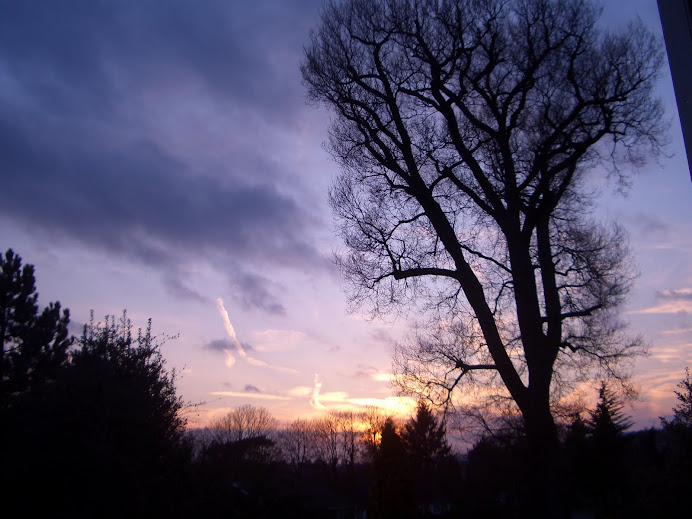
with vapor trails
Subscribe


 Posts
All Comments
Posts
All Comments