"The penalty good men pay for indifference to public affairs is to be ruled by evil men." attributed to Plato

"Bad men need nothing more to compass their ends, than that good men should look on and do nothing." attributed to Edmund Burke

Let's between us make the world a better place.


Showing posts with label Rodney Shakespeare. Show all posts

Thursday, 28 April 2011

How can we heal our flawed economy Part 1

 I have written over the last few weeks of the many flaws in our current Western economic model. But how can we build a better, more sustainable and fair system?

Economists, philosophers, theologians and more have contributed to the debate on the way forward for our economy in the context of addressing the world’s often seemingly insuperable problems. Our economic system is certainly not serving us well at the moment in its present form. Perhaps this is the opportunity to consider other options that address some of the present flaws. We do urgently need a system that promotes human justice and that stresses the importance of the long-term sustainability and protection of our planet. Where can we find this?

One such organization that works within these parameters is The Global Justice Movement. The essence of this movement’s message is an inclusive justice for all. It promotes policies that will provide a new, stable, just, global monetary system that will protect the environment by its sustainability, address poverty and the present rich–poor divide, and focus on real productive economy.

It starts with the idea of national bank-issued interest-free loans that have a real link to productive capacity and the spreading of that productive capacity, arising from within society. It is opposed to interest bearing loans which are created without any link to production, which have no regard as to whether the needs of society are met and which are controlled by those with no concern for society. Global justice, it believes, ends with global peace.

So what is proposed? Binary economics is a system developed in the 1990s by Rodney Shakespeare with Robert Ashford that fits well within the aims of the Global Justice Movement. It is based on the principle that both capital and labor should physically produce wealth and that all individuals should have access to such capital, provided for them if necessary using interest free money. This could produce a secure source of income for everyone, regardless of age, ability or occupation. This new and refreshing idea has been woven into a complete re-thinking of economics and politics, expressed in a most extraordinary vision in Seven Steps to Justice, one of the most readable and potentially and profoundly life changing books I have come across.

If only people would listen to wise words.

© Eleanor Stoneham 2011

Thursday, 17 June 2010

World Economic Crisis, UK austerity cuts and Binary Economics

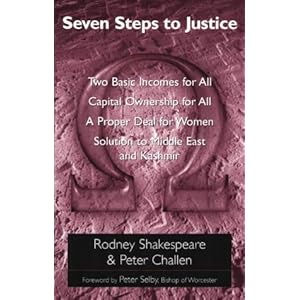
Seven Steps to Justice

On a day when our UK Tory Government has announced cuts of £2billion to previously planned public expenditure, because of lack of funds, I am forcefully reminded of Rodney Shakespeare and Peter Challen's book, Seven Steps to Justice.

Published in 2002, this deserves a much wider readership and recognition than it has received.
A short book, it has a wealth of profound insight and potentially far reaching recommendations for a fundamental change to our current financial systems, whilst written in an easy style that is accessible to all, without requiring any deep financial or economic background. And all this in just 150 pages.
The review by Wayne Strugeon provides a good summary of this book's main thrust. Another essential review is that of Norman Kurland, President of the Center for Economic and Social Justice Washington.
The key issue exposed by Shakespeare and Challen is that our current banking system creates money. Not only that, but it then claims ownership of that money by charging interest on it. What is more c. 97% of the money created annually comes from that banking system, with interest, and just 3% is government created, without any interest charge. Why does a government have to pay interest to the banks? Why are we almost totally controlled by the banks? Two good questions!
The authors go on to propose a neat alternative, which they have called Binary Economics, based on Louis Kelso's model (elsewhere described as the Third Alternative Economy.) The main object of this style of economics is to ensure that all individuals have access to earning through both capital ownership and the provision of their own labour, the only two ways, the book tells us, that we can genuinely earn.
The benefits of such a system are several. Most importantly, as the front cover notes, there would be two basic incomes available for all, capital ownership for all, a proper and fair deal for all women, and they even dare to propose solutions to the problems in the Middle East and Kashmir, based on this new style of economy. How wonderful is that?!
Unfortunately such radical proposals tend to get ignored because too many people caught up in the present system have too much to lose if the system changes.
Can we afford in the present world economic crisis to ignore other ideas? Let's at least open the debate.
If you have got this far, you may like to pursue the topic further in a blog of the Global Justice Movement, The Just Third Way.

It's Time you knew - by Transition Rachel at YouTube

Many reasons to love La Gomera

Madeira

Sunset

Sunset
with vapor trails

Followers

Total Pageviews