"The penalty good men pay for indifference to public affairs is to be ruled by evil men." attributed to Plato

"Bad men need nothing more to compass their ends, than that good men should look on and do nothing." attributed to Edmund Burke

Let's between us make the world a better place.


Showing posts with label human behaviour. Show all posts

Friday, 31 December 2010

Obsolete Beliefs and Aspirations

A month ago on this blog (23 November 2010) I posted a review of A New Renaissance – Transforming Science, Spirit and Society. This is a collection of 25 essays from acknowledged experts in their fields in response to a challenge from the Scientific and Medical Network to consider ways forward out of the socio-economic and ecological global crisis we find ourselves in.

The scene is set in the first chapter, written by Ervin Laszlo on The World’s Health Problem: an Integral Diagnosis. In his analysis, Laszlo concludes: “the world is (1) socially, economically and ecologically unsustainable, (2) saddled with irrational behaviours and (3) governed by obsolete beliefs and aspirations.” And over the next few weeks I want to consider one by one these irrational behavioural patterns and obsolete beliefs and aspirations, which he lists, before looking at possible solutions.

So here is the first obsolete belief: we think the Planet is inexhaustible, and this has guided our actions quite thoughtlessly for too long. We have carried on mining and extracting our fossil fuels without thinking that these have been laid down in the earth over hundreds of millions of years, and will take the same time scale to replenish. And we continue to fill our landfill sites to the brim with our waste, much of it toxic. We havn’t thought for a moment that the space available for rubbish is finite, or considered what happens as these massive rubbish piles degrade.

In his wonderful book Harmony, HRH Prince Charles tells us that “according to UN figures, the US alone buries 222 million tons of household waste a year” with China catching up with 148 million tons. The biggest immediate problem of these massive piles of waste is that they produce greenhouse gases that trap the earth’s heat and contribute significantly to the global warming and its effects that we now witness around us.

An early awareness of our violence against the natural environment probably came with James Lovelock’s invention in 1957 of the Electron Capture Detector, a device used for measuring chemical compounds in atmosphere and matter. This enabled the discovery of residual pesticides in the food we eat, the evidence for which Rachel Carson exposed to a general public in her book Silent Spring in 1963. In this she brought together the available research at that time on toxicology, ecology and epidemiology. She sought to put the world on alert as to the dangers ahead for humanity that she foresaw if we continued to use chemicals indiscriminately in our homes. She warned of the dangers of using such chemicals for agricultural and horticultural purposes, if we did not understand the possible long-term harm they may cause. She saw that the resultant build up of these substances in our food chain could be catastrophic to wild life environments and our own health. Most importantly, the book shattered our assumptions until then that the environment had an infinite capacity to absorb pollutants and maintain its own stability. Although much of what Carson wrote is now out of date, it shook our assumptions about chemicals, made us aware of chemical pollution for the first time, and kick started the ecological movement into action.

So why, Laszlo asks, do we behave so irrationally still? Why do we continue to run our global economy on polluting and finite fossil fuels when we have the technology to harvest energy from sun, wind, tide, geothermics and plants? Why indeed?
Einstein once said that we cannot solve a problem with the same kind of thinking that created our malady. Or in other words we cannot heal our planet and ourselves with the same kind of thinking that brought us to this current malady.
Laszlo tells us that we need a new kind of consciousness. Not only that, but there are signs around us that this is now emerging, a different kind of perception, of awareness, particularly in young people; a consciousness of connectedness and belonging, of oneness with nature. The evolution of this consciousness, Laszlo tells us, "is a precondition of healing our seriously damaged but not incurably sick planet."
I will look into this in more detail over the coming weeks as I consider some of the other irrational behavioural patterns and obsolete beliefs and aspirations listed by Laszlo that threaten our future.

Friday, 20 August 2010

Nudge


I have just returned from a weekend in Belgrade attending the wedding of Serbian friends - and have neglected this blog, so I now intend to make amends.

The image, by the way, is a detail of one of the mosaics being made for the adornment of the walls of the church of St. Sava, in the process of being built in that city.

********

It is said that dog owners get to look like their pets over time. Perhaps cat owners also grow to look like their feline friends. But have you ever noticed a couple grow to look alike over the years they live together?

For many years I commuted by train to London for my work. A couple regularly traveled on the same train. They would arrive at the platform together in the morning, and I would see them meet up together on the London platform to go home. They were a very devoted couple, both quite short, dumpy (meant in the politest way, not meant to offend), and clearly comfortable with each others' company without feeling the need for constant chatter.

The years went by and I stopped the commute, when I set up in business locally. And what a relief it was, to not have to join the crowded train, stand for miles of the journey, put up with coughs and colds all around me, and the increasing annoyance of listening to other people on their phones and of the jangle of their walkmen (who remembers those?!) from badly fitting earphones.

Many years have passed. I am now retired. And guess what? The other day I saw the very same couple - obviously now retired - walking together down our high street. And they now look so alike I was amazed. And clearly still happily together. But what is going on here?

Apparently it is true - people who live together really do get to look more like each other. Why? Partly apparently because of shared diets and nutrition. We are, after all, what we eat, so it is said. But much is due to the fact that we imitate facial expressions and are susceptible to other social influences. And, incidentally, couple who end up looking like each other tend to be happier!

This is not just quirky information with no significance. In fact social influences can determine the way our society develops.

I am reading Nudge, the bestselling book by Thaler and Sunstein, the book I would love to have written myself, as it explains how human behaviour can be changed by.....nudging! This has enormous potential significance for our future and is a fascinating read. Do get it. Depending on who reads this and the action they then take, this book will change our lives for ever, for better or worse.

Monday, 18 January 2010

Busyness

Following on from my last post, I believe another reason for inertia is the “busyness” of so many of us – the inability to be able to sit back and reflect on individual responsibilities – how we can effect change from the bottom up – instead we look to management to make change– or Government to make laws – but that is not the right way forward.

Leo Tolstoy once said: “In the name of God, stop a moment, cease your work, look around you.” Most of us need to do just that once in a while, to reappraise where we are frantically hurrying, to consider the effect of our actions on those around us and on the future of the world. Perhaps we have Benjamin Franklin to blame when, at the dawn of the Industrial Revolution, he declared that “Time is Money” and our busyness has been fuelled by greed ever since.

I really liked this photo - was taken in the same area where I took the picture of the crooked house in the last post!! Any idea where this is?

The need for a Dunkerque spirit.

The planet is in a bad way - surely few can disagree with that statement. And there are lots of ideas around for the reason why, and for what can be done to help secure a better future for us all. My theme is that we need a return to spirituality - and that the vulnerability and compassion of the Wounded Healer can play a part. Meanwhile years tick by as we crawl inexorably towards a precipice - beyond the point of no return even. Gloomy prognosis? Yes, perhaps, but I am sure it reflects the truth!

But I have often wondered why it seems to take so long for obvious truths to be heeded, and for action to be taken when solutions to problems sometimes seem so clear. Our greed and mass consumerism is surely unsustainable. But what drives us to this? And why does behavioural change often seem so slow, even if we accept that such change is needed. Let's leave it to the next man, we say. why should we be the first to start change?

Some say that as humans we actually need a sense of urgency, a Dunkerque kind of mentality before we will all pull together as a race to save our fellow beings. This may well be so. We all know how easy it is to procrastinate around our less favourite activities, revising for exams for example, until the last possible moment. Sometimes good ideas for change can be buried in cumbersome and unwieldy bureaucracy. Sometimes effective leadership is missing.

Ignorance is often to blame. Obviously, busy individuals do not tend to read books and textbooks outside their own spheres, and specialists do not tend to look beyond their own fields to the wider significance of their knowledge and skill – often having quite enough to do in their own work! Too often it seems that wisdom is then lost within the pages of a book – good ideas do not always convert into positive action - and are never developed further. And even the most respected media will distort facts either by accident or design to grab headline attention.

Am I right? Is there hope?

please let me have some thoughts!

By the way I liked the photo and I guess it has some relevance to the topic!! Any one like to hazard a guess as to where I took it?!

It's Time you knew - by Transition Rachel at YouTube

Many reasons to love La Gomera

Madeira

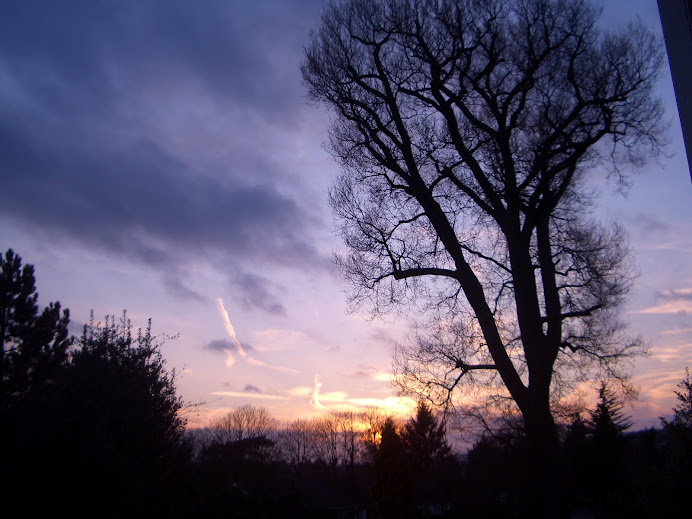
Sunset

Sunset
with vapor trails

Followers

Total Pageviews