"The penalty good men pay for indifference to public affairs is to be ruled by evil men." attributed to Plato

"Bad men need nothing more to compass their ends, than that good men should look on and do nothing." attributed to Edmund Burke

Let's between us make the world a better place.


Showing posts with label Nun's Valley. Show all posts

Sunday, 12 June 2011

The Rainbow and God's Covenant

"I set My rainbow in the cloud,and it shall be for the sign of the covenant between Me and the Earth.....and I will remember My covenant....the waters shall never again become a flood to destroy all flesh."

Genesis Ch. 9 vv. 13, 15.


If you look closely the second rainbow is just visible above the first one in the last picture - I didn't get to my camera quite quickly enough.
The valley is Nun's Valley in Madeira.

Saturday, 12 February 2011

Thursday, 16 December 2010

The Wounded Healer in the Community?

“In and through community lies the salvation of the world.” M S Peck


This is an expansion of a blog on community I published not so long ago. It is such an important subject for today's world.
M. Scott Peck became well known in the 1970s and 1980s for his best selling books on personal spiritual growth. He is probably best remembered for The Road Less Traveled and Further Along the Road Less Traveled. He also made a study of community building and its role in achieving world peace, and he wrote this up for the popular market in his book The Different Drum. His books continue to sell well and are just as relevant in today’s world.
In his book Peck defined the basic community as “a group of individuals who have learned how to communicate honestly with each other, whose relationships go deeper than their masks of composure, and who have developed some significant commitment to ‘rejoice together, mourn together,’ and to ‘delight in each other, make others’ conditions our own.”This definition emphasizes the need for vulnerability amongst the members of a community. It sets up the conditions for healing and wholeness in an atmosphere of mutual trust.
A participant in one of M Scott Peck’s community building workshops observed that ‘the greatest gift we can give each other is our own woundedness.’ Only the wounded, says Peck, can heal community.This story is obviously quite old, but some ideas are timeless, hence we talk of the need in today's world for Ancient Wisdom.
Real honesty and openness, two of his community-making principles, require us to be vulnerable, to have a willingness to be wounded. In The Different Drum, he writes at length on vulnerability in community building. The danger of invulnerability, he warns, of acting as a ‘cool cat,’ is that psychological defences are put up between the two parties, and the relationship between them becomes nothing more than ‘ two empty tanks bumping against each other in the night.’ He talks of a ‘peace through weakness’ strategy to build community, at all levels. ‘For the reality is that …. there can be no community without vulnerability; and there can be no peace – ultimately no life – without community.’ And this involves taking the risk of showing our vulnerability.
Alastair McIntosh is a Scottish human ecologist, writer and campaigner. If “humankind is to have any hope of changing the world,” he writes in his wonderful book Soil and Soul, “we must constantly work to strengthen community.”We will achieve this only by “coming alive to community with one another, with the place where we live, and with soul.” This, he says, recognizes “a Celtic truth about identity, which is actually a deep human truth: a person belongs only inasmuch as they are willing to cherish and be cherished by a place and its peoples.”
A lovely thought.
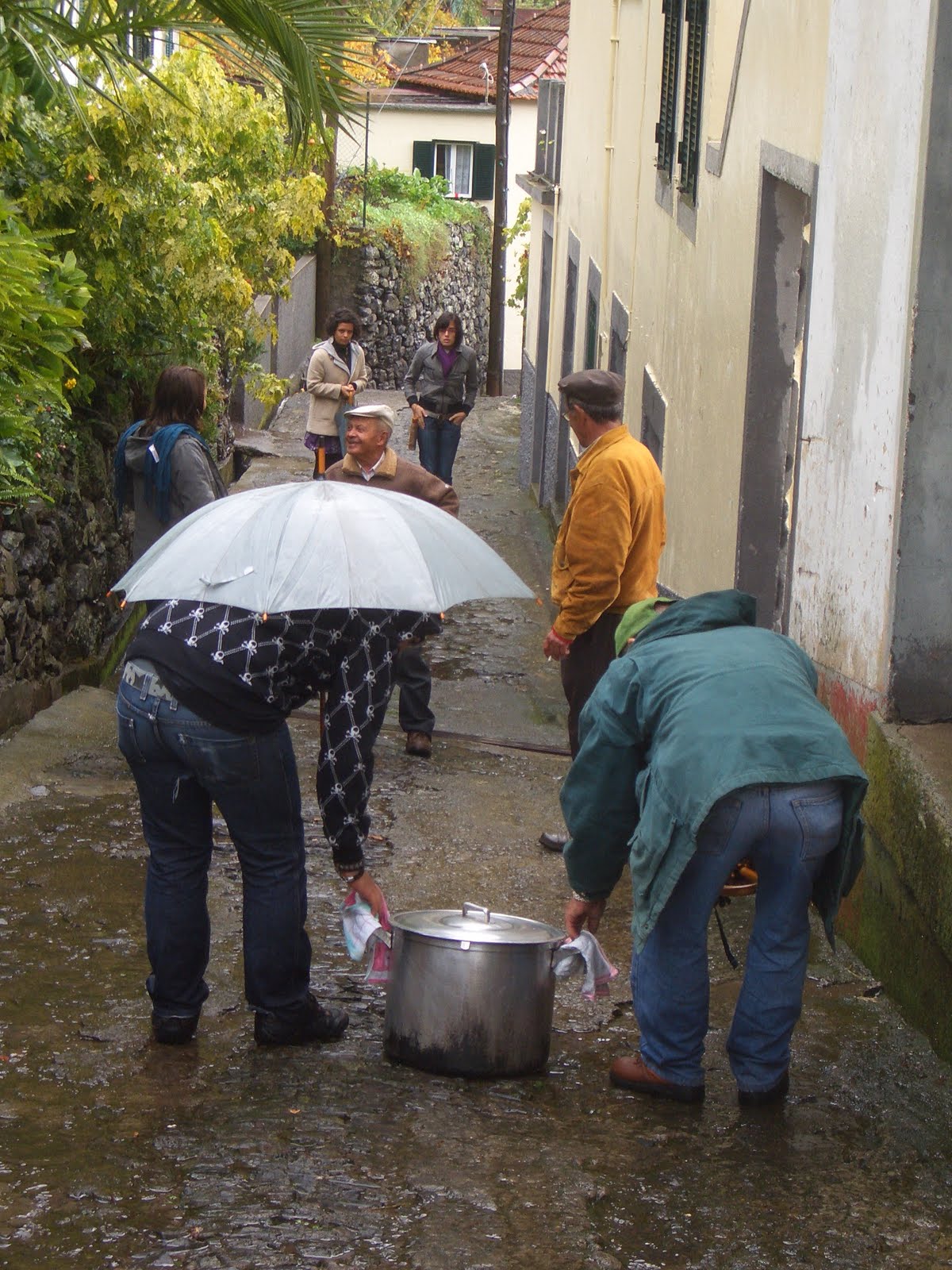
The photo is of the Chestnut Festival in Nuns Valley in Madeira.It was raining, as we say, "cats and dogs" but the community spirit there was palpable - you could feel it in spite of the discomforts of the heaviest rain they had seen for years.

Tuesday, 28 September 2010

Creation in Crisis; Christian Perspectives on Sustainability Part Two

I took this book to bed again last night and made significant inroads into its depths. It is so good, that today I have read much more of it and will be posting a review on Amazon soon.
Christian or not, we really do need to heed its message. After all, one argument often used by atheists against the need for religion is that there is no need of a faith or a God for them to have their own strong morals and ethics. We can, they say, be good without God.
OK, so the actions urged in this book have very strong ethical and moral support, albeit from Christian teachings. Any "good" atheist true to his own beliefs should also therefore find himself unable to ignore the reasoning in this book, founded very much on the scale of human suffering that will result from man's past actions exacerbated by the extent of any future inaction.

Sir John Houghton is currently Honorary Scientist of the Hadley Centre for Climate Prediction and Research at the UK Meteorological Office, but his experience and qualifications as an eminent scientist over 40 years are immense. He of all scientists will most certainly know what he is talking about. He is also one of those many scientists, eminent and otherwise, who contrary to a common misperception, also feel able to have a faith, a religion. He is a Christian. And his own chapter in Creation in Crisis, Sustainable Climate and the Future of Energy, makes frightening reading indeed.

This is just a small snatch of part of his message for the climate change cynics:
"...it is only during the past century that increases in human population and the development of large-scale industry have begun to have widespread and severe effects on our climate...The change we are experiencing and which is rapidly growing is ...unsustainable because its impacts are largely adverse and will negatively affect our children and subsequent generations, many human communities (especially the poor and disadvantaged) and many ecosystems, which will experience great losses of species and biodiversity."
What adverse phenomena can we expect? The most worrying aspect is the projected rise in climate change refugees, displaced by a combination of flooding of their homelands, and extreme droughts, which will be longer and more severe as we advance into this century. A cautious estimate predicts that by 2050 there will be more than 150 million refugees, human tragedy on a vast scale. Where do they all go? How does the earth cope?
And no assessment on any other scientific topic, he assures us, has been so thoroughly researched and reviewed as the results of the IPCC's assessments and related reports.
Creation in Crisis reinforces the serious of climate change, looks in detail at all the causes, points to the possible solutions, and all within a Christian perspective. The overriding message is very clear. We have to reduce our greenhouse gas emissions, and we have to act urgently. We also have to adapt to changes already happening, and unavoidable. We need to work on improved water defences, land management, water management, crop management, all to counter soil erosion, flooding, drought and heat. And we need a global cooperation. We also need the determination of us all, as encouraged and incentivised by governments. We need to work much more on energy efficiency, on developing non fossil fuels, on carbon capture and storage, and we need to act with a sense of urgency, akin to the mobilisation for war seen in 1941 by Roosevelt's government, or the British rally seen a couple of years earlier at the onset of World War Two.
Most of all, the book in its many and varied essays, emphasises the high level commitment and behavioural adaptations needed by you and I, now. For this to happen we have to really and truly understand, in our hearts and minds, that human well-being does NOT grow with economic growth, with consumerism and with excessive material comfort. This understanding MUST be promoted by the advertising industry and by those who guide and direct the economies of the nations.
There is so much good scientific fact, straight common sense and well reasoned ideas in this book. It is the very best from the finest scientific and theological minds. I can only say if you care at all about the future of this planet, about the future of your children and grandchildren, about the whole of humanity, (and ethically that must include us all) this book must be read; not only read, but recommended to others, and acted upon by all of us even if only in some small way, to start our own Ripple of Hope.
The photos by the way are off the book cover and attributed to Shutterstock. The refugees are crossing from DR Congo to Uganda. The car speaks for itself.


Here is a photo I took in the Nun's Valley in Madeira at the time of the Chestnut Festival held every November. This weather was exceptional for the area. The locals did not appear to have seen anything quite like it before. Clearly this was a part of the exceptional weather patterns resulting from climate change as predicted by the science and described by John Laughton.

Monday, 21 June 2010

Community - Fear and Happiness in the 21st Century


I came in from the garden the other morning in time to hear the last few intriguing minutes of a discussion on BBC Radio 4's Woman's Hour. Host Jenni Murray and her guests were talking about gated roads and the importance of belonging to community and the current fear culture that seems so prevalent in our neighbourhoods.

On following up the programme on the Radio 4 website I found one of the guests to be Anna Minton, and discovered that she has written a book around this theme, Ground Control: Fear and happiness in the twenty-first-century city (Paperback Penguin Books - 25 Jun 2009)

This attracted my attention as a subject dear to my own heart.

If we sense that our boundaries are being threatened, it is a natural human reaction to feel insecure or suspicious. We are afraid that our identities may be lost. Fear can breed violence and aggression, which then becomes a real obstacle to any attempts at community building. And this applies as much to the inclusive faith group or the national culture as it does on the faceless and impersonal track housing or housing estate we have created, or in the inner cities.

When barriers are in any way dissolved, it is important to ensure that individual and group identities continue to be preserved and respected in their overall unity. The one great melting pot that we dreamed of in the “swinging sixties” where all differences would be watered down and identities lost will never work. And why should we want to bring all colors and cultures and faiths and backgrounds into one homogeneous mush anyway? We have to learn to celebrate all our differences of faith and creed and culture in a spirit of respect and understanding and indeed joy. Judaism has a set of principles known as Darkhei Shalom, meaning “how to live graciously with people whose beliefs and way of life are incompatible (with the Jewish faith). Despite profound differences, we must engage in common citizenship, contributing to the welfare of other communities as well as our own,” writes Jonathan Sacks in To Heal a Fractured World.


This needs real community. It needs community at all levels, local, national and international, if we are all to learn to live together in perfect harmony. “Beware above all of everything that isolates, that refuses to accept and that divides,” Pierre Teilhard de Chardin warns. “Each along your own line, let your thought and action be ‘universal’ which is to say ‘total’. And tomorrow may be you will find to your surprise that all opposition has disappeared and you can love one another.” (Activation of Energy 1970 p.95)

We should perhaps remember that most of the war and conflict in the world today is defensive rather than aggressive. Much of the violence and pain we see around us has been interpreted in the context of Teilhard’s theories, as being the result of our failures to adapt and evolve alongside the move we have so rapidly made towards global convergence. This suffering has been likened to the pathological birth pangs of a new world order, a world in need of healing. Man has to learn, he says, not to give up security, which is psychologically impossible, but to trade in the old security of fences, boundaries, guns and bombs, for the new security of openness and trust in bonds of relationship, mutual support, brotherhood and love. And that means real community.

Of course the worth or otherwise of a visionary’s words can only be tested by the passage of time, but Teilhard’s visions seem to be attracting ever more followers as we struggle to understand our seemingly precarious future in this twenty first century.

Bonds of mutual support, brotherhood and love seem far removed from the gated private roads, the houses surrounded by overtly secure and impenetrable security gates, the intercom devices to gain entry. Such exclusiveness continues to isolate and divide. I believe strongly that it is misguided and harmful to achieving any real community. It removes us from being a part of the spirit and soul of a place.

We have the first responsibility to make change in our societies and communities. Governments with their laws and regulations can only provide the supportive framework within which we make these changes. Governments can fight the injustices of low minimum wages, non-existent healthcare for so many, lack of security in sickness and retirement, and the huge divide between the richest and the poorest of our society. They can make the tax codes which support the status of marriage and family, that either help parents stay at home with children or force them back into the workplace.

But most of all I believe we need spiritual politicians who are compassionate, indeed empathic to the needs of the populace. In fact we need spirituality, compassion, empathy, and good old-fashioned moral responsibility all round. And we need changes of heart and mind in us all.


And the picture? It is of the Chestnut Festival in the Nun's Valley in Madeira - during a tremendous rain storm which threatened to totally close down the event. But community spirit and neighbourliness prevailed against all the odds!

Friday, 12 March 2010

Climate Change and Global Warming

I don't know what triggered my mind to do this, but yesterday I googled my scientific paper that I wrote with my supervisor on, wait for it, The Surface Phosphatase Activity of Roots of Beech Mycorrhiza. I was amazed that something I wrote in 1973 (in my maiden name) was now floating around in cyberspace, and just a little flattered that quite a few scientists still see fit to cite it in their own works! This was after all my subject for my PhD thesis, and for a long time afterwards I felt disillusioned as to the usefulness of this work in the grand scheme of things!

Perhaps I should not have been so doubtful!
The lesson from this small exercise in narcissism is that science is an art! There is a misunderstanding prevalent among many in the general non scientific public that scientific experiments categorically prove something to be true or false. This in many cases is simply not so. Scientists devise experiments around hypotheses and conclusions are made around probabilities and relative weight of evidence one way or another.
All this is very relevant to the current debates on climate change.

A Times poll in 2009 found that only two in five Britons believed that this current and visible problem was largely man made. But those that still harbor any doubts that we are in any way responsible for climate change should heed the report to world leaders by the United Nations Intergovernmental Panel on Climate Change (IPCC) following its meeting in Paris at the start of 2007. This report concludes that it is very likely (and that means a 90% chance!) that the activities of man are responsible for the increased greenhouse gases and the resultant problems of climate change now being seen and predicted for the foreseeable future. As a consequence average temperatures are likely to rise by 4°C by the end of the century. This is the consensus of opinion from the combined efforts of more than 800 contributing authors and more than 450 lead authors, with more than 2500 scientific expert reviewers involved in the two-stage scientific and technical review process. So what is there to doubt?


For the continuing cynics why not use an adaptation of Pascal’s Wager? Pascal reasoned that whether or not one believed in the existence of God, it was a safer bet and one had nothing to lose by supposing that He existed. So it is with the global warming debate. If we allow ourselves to become more spiritually aware, more sensitive to our finely balanced place in the world, more compassionate towards the plight of our brethren across the globe, more simple in our needs, more at peace with ourselves, more in tune with our own souls and the soul beneath our feet, then are we not alll enriched? We will certainly be happier, and we will be leaving a better world for those who come after us. What do we have to lose?

There are bound to be some controversies and debates surrounding the details of the IPCC report and the scale of its significance. Much of our best scientific research effort is being directed towards gaining a fuller understanding of all the issues involved, and what actions we can take.

We saw the distress that extreme weather can inflict in the 2005 devastation of New Orleans by Hurricane Katrina. Even those who cannot quite believe or accept the evidence for the part humankind may be playing in climate change cannot deny the extent of human suffering now seen on a global scale. This then becomes more than a debate on climate change. It becomes a matter of human compassion and justice. These injustices brew a potentially dangerous potion of civil unrest and worse. There is a social and moral imperative for us all to share everything, to watch out for each other, to work for global healing. I believe we can no longer ignore our global responsibilities.
These photos by the way are from the Nun's Valley in Madeira when there annual chestnut festival was washed out by the most extraordinary rain in November 2008. The capital Funchal of course suffered even more from freak weather in February 2010.

It's Time you knew - by Transition Rachel at YouTube

Many reasons to love La Gomera

Madeira

Sunset

Sunset
with vapor trails

Followers

Total Pageviews