“Neither a borrower nor a lender be;” said Polonius in Shakespeare’s Hamlet.
”For loan oft loses both itself and friend,
And borrowing dulls the edge of husbandry.”1
I have been writing recently of various flaws in our Western economic model. I have discussed the fact that the model as it stands is simply not sustainable, and does not value the human input. Now I come to the part that always amazes many people; Money can be created out of nothing.2
This happens when it is created by bank debt against the payment of interest. It is fiat money. This is not widely understood by the general public outside the banking world and usually comes as a surprise. A Canadian journalist has estimated that only one person in a thousand really understands how money is made!3 It is certainly not something that is widely publicized. What is more each bank also has what it calls its Reserve Ratio. This means the proportion of cash invested into its bank deposit accounts that the bank estimates it needs to retain in case the customer wishes to withdraw again against their deposit. If for example £1000 is put on deposit with the bank and they calculate their Reserve Ratio to be 10%, then they reserve £100 and the remaining 90% of the deposit or £900 is available for the bank to lend on. And it does. The bank sets up a loan of £900 to another customer for interest, neatly increasing the supply of money available in the economy by a simple accounting entry in its books. The bank has not only made money out of nothing but it is also making an interest profit on that money that it has created out of nothing. And the bank almost certainly charged a fee for arranging the loan as well. The more times the same money can be recycled and recreated in this way the greater the arrangement fees and the interest profit that the bank can make, all from the creation of illusory money out of nothing. What is more, the amount borrowed by the customer is likely to be placed on deposit again elsewhere and the creation of further debt out of nothing can continue in another bank. The multiplier effect of this exponential increase in debt is astounding and very dangerous.
Money has to continue to grow to maintain this system and to avoid financial collapse, even though actual standards of living may remain stagnant. With consumer spending the lifeblood of the economy and a personal consumption now nearing 75% of GDP, which truthful and brave politician will urge us to spend less? It is not hard to see that such a system is unjust and unsustainable. (A government can and does make money out of nothing also, but this is only to the extent of new notes and coins it issues.)
As long ago as 1939 American President Abraham Lincoln warned that: ‘The Government should create, issue, and circulate all the currency and credits needed to satisfy the spending power of the Government and the buying power of consumers. By the adoption of these principles, the taxpayers will be saved immense sums of interest.’4 But fiat money is still issued by banks.
I was shocked when I read that 98% of the $2 trillion changing hands in the foreign exchange markets each day is purely speculative and has nothing to do with wealth creation. Only the remaining 2% relates to real goods and services.5 As Edward Cahn observes: ‘Money has taken on a life of its own: its function is to produce for the sake of reproducing – regardless of the impact on the health of the human community… increasingly what we are witnessing in the world’s money markets looks more and more like cancer.’6 Cancer is dangerous and often fatal, requiring unpleasant treatments along the way.
In such loan systems there is an impersonal relationship between the borrower and the lender with a minimal flow of information needed between them. Such loans are therefore cheaper to administer. In addition the tax system favors such business fund raising by allowing tax relief on the related interest.
Because such loans are not linked to the success or otherwise of the business, there is no reward to the lender if the business is successful and conversely the lender can foreclose on an ailing business that can no longer afford to repay. This makes the problems of the business worse and it may need to curtail its production and make efficiencies of staff by laying-off, with all the inherent human and social consequences that then arise. This is of course harmful to the economic cycle, and means that interest based economies have exaggerated cycles of ‘boom and bust’.
One of the most harmful aspects of this interest on loans is that it is almost invariably charged by compounding year on year. Typically a home ‘owner’ with a mortgage will pay at least 2-3 times the original loan before the mortgage is fully paid off.
Our debts on credit cards have also reached massive amounts and many regularly pay double figure interest rates on their cards each year. A significant number of college students and undergraduates have credit cards and amass debt on these as well as on their other student loans. This encourages an extravagant attitude of spending among students who no longer need to budget expenditure within their means.
When I first wrote of these imperfections in our debt system a few years ago I was saying that alarm bells should ring. I was far from alone. In 2001 Bernard Lietaer predicted a 50:50 chance of a global money meltdown within 5-10 years unless steps were taken to heal what he called the global foreign exchange casino.7 It feels that we have drifted perilously close to that meltdown.
Unfortunately those in charge of our finances do not appear to consider alternative economic models. They want us to spend and consume our way out of recession. The problems and dangers of debt, at personal, corporate, national and international levels, are the cause of huge social disease. Such debt involves the transfer of wealth from the poor to those who are already wealthy. The system does not reflect the skill or the labor of the participant and encourages short termism.8 Interest based economies cause unemployment, social violence and pollution.9
Sabine McNeill, organizer of the Forum for Stable Currencies, and co-founder with John Courtneidge of the Campaign for Interest-Free Money, observes that ‘compound interest is for the monetary system what carbon dioxide is for the earth’s atmosphere: man-made and unsustainable.’10
And that is no way to heal our wounded earth.
The good news is that there are sustainable economic systems that could be used if our governments had the courage to change. Few of us as individuals really understand the economy and how it works, or appreciate that we could be making a difference in this sphere. Nonetheless there are millions of citizens worldwide who are already making their own practical contributions to a fairer and more sustainable economic system using some of the ideas that I will come back to describe and explore in later posts.
References:
1. Lord Polonius in Shakespeare's Hamlet, 1603.
2. See for example Darryl Schoon, 2008.
3. Cited on the Forum for Stable Currencies website
4. Senate Document 23, 1939 http://www.uhuh.com/unreal/lincoln.htm 3 March 2009.
5. Bernard Lietaer, 2001.
6. Edgar S Cahn, 2000, p. 68.
7. Bernard Lietaer, 2001.
8. Bernard Lietaer, 1997.
9. The Campaign for Interest-Free Money at http://www.interestfreemoney.org/index.htm 3 March 2009.
10. http://www.monies.cc/ 3 March 2009
© Eleanor Stoneham 2011
Showing posts with label economy. Show all posts
Showing posts with label economy. Show all posts
Tuesday, 5 April 2011


Wednesday, 30 March 2011
Flaws in our Economy - We cannot sustain our present financial systems
There is massive wastage in our consumer society, both from personal consumption and in our industrial processes. Alarming statistics can be found of physical waste:
Americans apparently waste or cause to be wasted nearly 1 million pounds of materials per person per year…[and] this does not account for wastes generated overseas on [their] behalf…the amount of waste generated to make a laptop computer is close to 4000 times its weight.*
 There is a beautifully sustainable cycle within nature. Dead bodies provide food for living creatures, plants photosynthesize and produce oxygen from carbon dioxide and animals use that oxygen in their respiration of which the by-product is carbon dioxide. At school we learnt all about this and called it the Carbon Cycle, little suspecting that 50 years later this would have such a fundamental significance for the future of the world!
If we can see the Earth as a single living entity involving complex interrelationships and a finely tuned balance of all life, as envisioned for example by James Lovelock, should it not be logical for a sustainable economy to mimic that natural world, indeed be a part of that world, where everything is recycled, everything has a further use elsewhere. We would then be able to build a system that is totally cyclical and sustainable and environmentally sound.But we are very far from doing that at the moment.
Evolution biologist and futurist Elisabet Sahtouris once posed the question: doesn’t it seem crazy and so obviously illogical that our household finances and the study of how we make a living (or economy) should be so totally divorced from the study of how other species make a living (or ecology)?
This seems so simple and obvious but it also seems that we cannot see it!
*Paul Hawken and Amory and T. Hunter Lovins,1999, p. 52 cited in The Path to Living Economies – a collaborative Working Document of the Social Ventures Network
Americans apparently waste or cause to be wasted nearly 1 million pounds of materials per person per year…[and] this does not account for wastes generated overseas on [their] behalf…the amount of waste generated to make a laptop computer is close to 4000 times its weight.*

If we can see the Earth as a single living entity involving complex interrelationships and a finely tuned balance of all life, as envisioned for example by James Lovelock, should it not be logical for a sustainable economy to mimic that natural world, indeed be a part of that world, where everything is recycled, everything has a further use elsewhere. We would then be able to build a system that is totally cyclical and sustainable and environmentally sound.But we are very far from doing that at the moment.
Evolution biologist and futurist Elisabet Sahtouris once posed the question: doesn’t it seem crazy and so obviously illogical that our household finances and the study of how we make a living (or economy) should be so totally divorced from the study of how other species make a living (or ecology)?
This seems so simple and obvious but it also seems that we cannot see it!
*Paul Hawken and Amory and T. Hunter Lovins,1999, p. 52 cited in The Path to Living Economies – a collaborative Working Document of the Social Ventures Network
Monday, 28 March 2011
Flaws in our Economy - Humans are not Valued
I have been writing about money and our economy, and last Thursday I said that we had to start with our own spending patterns, and how these may be flawed.
Now I turn to flaws in our economy.
Number One - Humans are not valued
A very large number of people in our society are presently undervalued or not valued at all in monetary terms. These include the old and young, the infirm and disabled, the housewives and the many community and charity volunteers without whom many organizations would simply not survive. All of these people outside the conventional workforce often work very much harder and longer hours than many in full time employment. But they gain no financial independence or recognition within the economic framework from their toil.
 I know of a wife who for two decades has selflessly cared full time for an increasingly and profoundly disabled husband. Or I think of the mother who takes a career break to raise her own children. These women both lead enormously valuable lives, but feel undervalued.
We measure a ‘healthy’ economy in terms of the material wealth or prosperity that is created by and for its working citizens, expressed in terms such as the gross domestic product (GDP), gross domestic income (GDI) or gross national product (GNP). Now in this current financial crisis the emphasis is on the need for growth in the economy. Whichever measure is used, they all put a zero valuation on the environment, on healthy citizens, on social cohesion and cultural values!
As Robert Kennedy once said:
 …the (Gross National Product) does not allow for the health of our children, the quality of their education, or the joy of their play. It does not include the beauty of our poetry or the strength of our marriages… It measures neither our wit nor our courage, neither our wisdom nor our learning, neither our compassion nor our devotion to our country, it measures everything, in short, except that which makes life worthwhile. And it tells us everything about America except why we are proud that we are Americans...
And these thoughts are relevant for us all, whatever our race or color or creed.
Now I turn to flaws in our economy.
Number One - Humans are not valued
A very large number of people in our society are presently undervalued or not valued at all in monetary terms. These include the old and young, the infirm and disabled, the housewives and the many community and charity volunteers without whom many organizations would simply not survive. All of these people outside the conventional workforce often work very much harder and longer hours than many in full time employment. But they gain no financial independence or recognition within the economic framework from their toil.

We measure a ‘healthy’ economy in terms of the material wealth or prosperity that is created by and for its working citizens, expressed in terms such as the gross domestic product (GDP), gross domestic income (GDI) or gross national product (GNP). Now in this current financial crisis the emphasis is on the need for growth in the economy. Whichever measure is used, they all put a zero valuation on the environment, on healthy citizens, on social cohesion and cultural values!
As Robert Kennedy once said:

And these thoughts are relevant for us all, whatever our race or color or creed.
Friday, 14 January 2011
Obsolete Beliefs numbers 3 and 4
 Over the last few weeks I have written about the essay by Ervin Laszlo on “The World’s Health Problem: an Integral Diagnosis” in A New Renaissance – Transforming Science, Spirit and Society. Laszlo concludes: “the world is (1) socially, economically and ecologically unsustainable, (2) saddled with irrational behaviours and (3) governed by obsolete beliefs and aspirations.”
I have covered the first two obsolete beliefs in previous blogs: that we think the planet is inexhaustible, and that we believe that “nature is a mechanism.”
Here is Obsolete Belief number 3: Life is a struggle where only the fittest survive.
“The (mal) adaptation of Darwin’s theory of natural selection to society,” Laszlo writes, “produces a growing gap between rich and poor, and concentrates wealth and power in the hands of a small group of smart but often unscrupulous managers and speculators.”
And here is his Obsolete Belief number 4, which is closely linked to number 3: The Market Distributes Benefits.” Affluent people tend to hold on to the belief that the free market, governed by what Adam Smith called the “invisible hand,” distributes the benefits of economic activity…the poverty and marginalization of nearly half of the world’s population,” he writes, “is eloquent testimony to the fact that this tenet doesn’t work in the context of today’s power- and wealth-distorted global markets.”
While we enjoy material riches, real poverty is indeed rife and 923 million people across the world are hungry. In addition, almost 16,000 children die every day from hunger-related causes. That’s one child every five seconds. Yes, one child dies from hunger every five seconds.
The injustices of the rich/poor divide bring discontent and envy, particularly with the globalization of information. Poverty brings disease and lack of education, which itself perpetuates that poverty. Lack of resources also increases vulnerability to natural disasters that in the developed nations we are broadly speaking better able to handle. Inadequate and poor quality housing exacerbates the impact of floods, hurricanes, tsunamis and earthquakes. Although we often call such disasters ‘Acts of God’ there is evidence that some of these ‘natural’ disasters are linked to man’s own interference with the planet. There is widespread homelessness, and a devastating AIDS/HIV crisis. I have seen various estimates of the number of children who will be orphaned by AIDS in Africa by 2010, ranging from 20 million to 50 million. Even the lower figure is appalling.
These statistics are an affront to our humanity. We need to do all we can to lift the most disadvantaged in our world out of poverty. This is a matter of justice and it is a matter of human compassion.
In 1976 an economics professor Dr Muhammad Yunus conducted an experiment. He gave the equivalent of $26 to each of 42 workers. From this they all bought materials, spent a day weaving chairs or making pots and were able to sell their wares and repay the loans. Thus was born the concept of microcredit.
Microcredit refers to small loans of less than a few hundred dollars, with no collateral, at nil or no more than commercial interest rates, made to help the poorest of the poor in the third world to start up small enterprises. This enables them to spread their productive capacity and gain some measure of independence and a better standard of living. For Yunus’ subsequent work with Grameen Bank, which was founded to foster this use of microcredit, the 2006 Nobel Peace Prize was awarded to them both in equal shares, for ‘their efforts to create economic and social development from below’, while improving the lives of millions of people in Yunus’ native Bangladesh.
Every person we help out of poverty, and towards independence, contributes towards making the world a better place for us all.
We cannot all be in the front line, at the sharp end of humanitarian relief efforts. But we can all make a contribution, however small, to reputable aid agencies to help and support them in their work.
I have a Cooperative Community card. Every time I shop at the Co-op, one penny is taken from me for every £1 I spend, and given to local deserving charities. What a fine and painless way of helping the community where we live, helping to make it a better place for us all.
The picture, by the way, is from the cover of Creation in Crisis; Christian Perspectives on Sustainability that I have reviewed previously.
Thursday, 4 February 2010
A Fragile Economic Recovery
"When the last tree is cut, the last river poisoned, and the last fish dead, we will discover that we can't eat money..." (words on a Greenpeace banner)
I am reading Jim Wallis’ latest book, Rediscovering Values – On Wall Street, Main Street and Your Street (A Moral Compass for the New Economy) and I was reminded of an article I wrote back in 2008 – and thought it was worth repeating – a little updated.
Do let me have your views.
 But pause and think. Would we as individuals eat everything in our own fridge and leave our elderly and young, our disabled and disadvantaged, all those living under our same roof, without any food and care? Of course not! But that is what we are doing. Because that is the reality of the world today. It is one global household, and we should behave accordingly.
We have to find ways to live more sustainable lives in a world where we can be sure that our good fortune is shared, where everyone has their basic human needs met, where both extremes of wealth and poverty become history.
We have lost our simple values, the art of love and respect and reverence for all living beings, animal and plant and human, the ability to understand ourselves as being part of a finely balanced world wide ecosystem, that together with the Earth we live on, we call Gaia. The economy of the world has to mimic the natural world and be totally cyclical and sustainable and environmentally sound. In nature everything is recycled – everything has a further use. Only if we behave with full understanding of our place within the living world, and build our economy accordingly – build it on principles of sustainability and justice for all – I believe that only then can we hope to heal this fractured world.
So what can we do?
We must support any initiatives that help people get back on their feet. We should support genuine Fair-trade, Traid-craft and other similar schemes wherever we can. We should curb our over consumption and wasteful behaviour, and use local charity shops, the Internet Freecycle facility and our recycling facilities wherever possible.
And we can and must fight to bring ethical trading in from the bottom up – enquire where our goods are produced and in what conditions - eschew all cheap goods where we know that unethical working practices are present. If the information is not available, demand it.
Be responsible shareholders, employees, employers and consumers. Many of us will own stocks and shares in some way, even perhaps without realising it in our pension funds. Some of these shares may well be in companies that operate unethical work practices, deal in weapons, or otherwise demonstrate behaviours that we would not support or condone in our own families. Look for ethical investments before profit motivation and ensure that any financial advisers know your views.
As Employees, Board Members, Non Executive Directors, Trustees, do we take a stand, perhaps against strong opposition, for that which we know to be right? Or do we allow practices to persist that we are uncomfortable with? Do we know what our employer really does – not just at the superficial level of our daily employment – but also at grass roots? Are we absolutely comfortable with its trading practices, its markets, its environmental footprint?
And if not, what are we doing about it?
It may often seem that the individual does not have a voice. But we can have our say – we can influence others – it needs knowledge and courage, and the support of other like-minded people.
And we should all give our support to any movements that are working towards a fairer, safer and happier world for all. Visit for example the website of The Global Justice Movement and support its aims. "Global justice grows from within. It starts with endogenous money and ends with peace."
Finally remember the parables of Jesus in Luke Chapter 12. Do not store up surplus for the future, do not worry about how you will be fed and clothed. In the words of the well-known hymn by Karen Lafferty, "Seek ye first the Kingdom of God and His righteousness and all these things shall be added unto you, allelu, aleluia." This is not saying that we should not work to feed and clothe ourselves, but it is warning us of the dangers of materialism and all that this implies in our world.
This really only scratches the surface of a huge topic – let's have your views.
Eleanor
I am reading Jim Wallis’ latest book, Rediscovering Values – On Wall Street, Main Street and Your Street (A Moral Compass for the New Economy) and I was reminded of an article I wrote back in 2008 – and thought it was worth repeating – a little updated.
Do let me have your views.
I wrote this as global stock markets were in turmoil, rocked by the credit crunch and the banking crisis. Whilst stock markets may be a little stabilized, the situation is still clearly fragile. And many still feel the recession gnawing at their financially precarious lives, whilst bankers yet again take huge bonuses. Isn’t more of the same sort of economy just going to get us in the same mess again later? Is this not another warning to us all about the non-sustainability of our economic policies as fuelled by our individual behaviour?
The predominant "free market" system of finance capitalism that operates in the world today is perhaps not what it seems. Many believe that it is seriously flawed. It relies on the creation of fiat money by the banks and a crippling compound interest loan system. It does not value the person, it is fuelled by profit motivation, and it ignores the ancient wisdom of the Old Testament land and debt laws at its peril. It contributes to the malaise of the world, both internationally and at local and national level, by fuelling injustices, increasing the rich/poor divide, failing to protect the environment and helping to destroy probably the most important contribution to trust and security and happiness once a basic standard of living has been achieved – sound personal relationships at family and community level. Strong words I know, and maybe controversial!
We have to find ways to live more sustainable lives in a world where we can be sure that our good fortune is shared, where everyone has their basic human needs met, where both extremes of wealth and poverty become history.
We have lost our simple values, the art of love and respect and reverence for all living beings, animal and plant and human, the ability to understand ourselves as being part of a finely balanced world wide ecosystem, that together with the Earth we live on, we call Gaia. The economy of the world has to mimic the natural world and be totally cyclical and sustainable and environmentally sound. In nature everything is recycled – everything has a further use. Only if we behave with full understanding of our place within the living world, and build our economy accordingly – build it on principles of sustainability and justice for all – I believe that only then can we hope to heal this fractured world.
So what can we do?
We must support any initiatives that help people get back on their feet. We should support genuine Fair-trade, Traid-craft and other similar schemes wherever we can. We should curb our over consumption and wasteful behaviour, and use local charity shops, the Internet Freecycle facility and our recycling facilities wherever possible.
And we can and must fight to bring ethical trading in from the bottom up – enquire where our goods are produced and in what conditions - eschew all cheap goods where we know that unethical working practices are present. If the information is not available, demand it.
Be responsible shareholders, employees, employers and consumers. Many of us will own stocks and shares in some way, even perhaps without realising it in our pension funds. Some of these shares may well be in companies that operate unethical work practices, deal in weapons, or otherwise demonstrate behaviours that we would not support or condone in our own families. Look for ethical investments before profit motivation and ensure that any financial advisers know your views.
As Employees, Board Members, Non Executive Directors, Trustees, do we take a stand, perhaps against strong opposition, for that which we know to be right? Or do we allow practices to persist that we are uncomfortable with? Do we know what our employer really does – not just at the superficial level of our daily employment – but also at grass roots? Are we absolutely comfortable with its trading practices, its markets, its environmental footprint?
And if not, what are we doing about it?
It may often seem that the individual does not have a voice. But we can have our say – we can influence others – it needs knowledge and courage, and the support of other like-minded people.
And we should all give our support to any movements that are working towards a fairer, safer and happier world for all. Visit for example the website of The Global Justice Movement and support its aims. "Global justice grows from within. It starts with endogenous money and ends with peace."
Finally remember the parables of Jesus in Luke Chapter 12. Do not store up surplus for the future, do not worry about how you will be fed and clothed. In the words of the well-known hymn by Karen Lafferty, "Seek ye first the Kingdom of God and His righteousness and all these things shall be added unto you, allelu, aleluia." This is not saying that we should not work to feed and clothe ourselves, but it is warning us of the dangers of materialism and all that this implies in our world.
This really only scratches the surface of a huge topic – let's have your views.
Eleanor
Subscribe to:
Posts (Atom)
Sunset
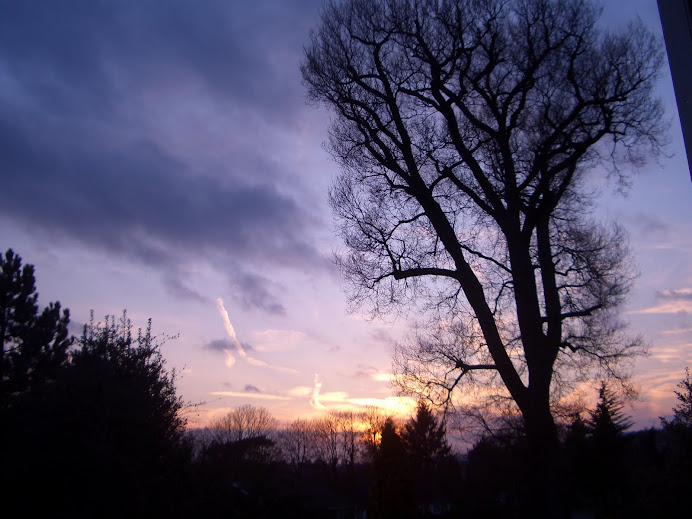
with vapor trails
Subscribe


 Posts
All Comments
Posts
All Comments