"The penalty good men pay for indifference to public affairs is to be ruled by evil men." attributed to Plato

"Bad men need nothing more to compass their ends, than that good men should look on and do nothing." attributed to Edmund Burke

Let's between us make the world a better place.


Showing posts with label philosophy. Show all posts

Tuesday, 12 July 2011

I'm Moving - and sculptures at Loseley Park

 "What gives me the greatest spiritual confidence is the knowledge that I'm moving. I know that I'm continuing to develop. Philosophically, spiritually, personally, I am not in the same place I was a decade ago, a year ago, or even six months ago. And as long as that's the case, I will have the confidence to stand up and talk about evolution."

This is not me speaking, although it could be. It is the opening sentences of Andrew Cohen's latest quote for the week, and I find it so true.
I feel that I have come a long way philosophically, spiritually, and personally over the last few months and years, encouraged and aided by the opportunities that have arisen out of my writing, and inspired and supported by the conferences I attend of the Scientific and Medical Network, an organisation that explores and expands the frontiers of science, medicine and spirituality. Do visit it's website.

and here are more photos of those amazing Zimsculpt sculptures at Loseley Park - sadly the exhibition has now moved on but the beautiful gardens are still there and surely looking at their best now.


Tuesday, 23 November 2010

A New Rennaisance; Transforming Science, Spirit and Society


E. F. Schumacher once said: “man is far too clever to be able to survive without wisdom.” And we now need that wisdom in large measure.

Someone said to me today: "the trouble is, (a phrase I dislike as much as "the problem is") there are so many books on this climate change stuff and other problems of our age, but nothing ever gets done."

That is simply not true, but there is always room to do more.

I went recently in London to a day conference at the University of London, the occasion being the launch of A New Renaissance; Transforming Science, Spirit and Society. This book was born out of a vision by the Scientific Medical Network of the urgent need for action to address the now deeply rooted and dangerous ecological, political and spiritual crisis in which we find ourselves.
Members of the Network were invited to submit essays on aspects of the crisis, which would discuss the causes of, and/or the paths beyond, the current crisis, to create an important repository of wisdom.

The predominant aim was to underpin a programme of action, to help the Network to “move boldly from theory to practice,” with progressive solutions, not only within the Network itself but by working with other like minded organisations and within the wider global community.

What we have now in this excellent volume is a compilation of 25 of the best essays, many of them from some of the world’s leading thinkers, bringing the latest scientific discoveries and philosophical ideas alongside ancient spiritual wisdoms.
The book is divided into four sections, under the headings; Worldviews in Transition, Consciousness and Mind in Science and Medicine, Spirituality and New Understandings of the Sacred, and finally Global and Local Transformation: Governance, Economics and Education (and also including, importantly, a chapter on the role of music and the arts in a possible future). This final part is most important, examining as it does some possible reforms in politics, economics and education, to help "bring forth a society that can sustain the flourishing of human beings in the twenty first century."

The scene is set in the first chapter (by Ervin Laszlo) by diagnosing the world’s own health problems –unsustainable living, irrational behaviours and obsolete beliefs and aspirations. But crisis brings opportunities for transformation, in enlightened politics, a more socially aware business ethic, and personal responsibility. And underlying all of this is the need for a greater spiritual awareness, a shift of our dominant consciousness towards a connectedness with each other and with the natural world, a new understanding of humans as psychic beings. This is a theme that occurs again and again in many of the essays; that rediscovery of our souls, or the spirit in matter, or a sense of the sacred, or changes in human consciousness in some way, will be essential for finding a more meaningful and spirit filled world and for healing our planet. And this new understanding of reality must acknowledge the inadequacy of reductionist materialism and the mechanistic scientific worldview.

Readers will not agree with everything here. Boundaries are being pushed to limits of thought and understanding, but there are common threads of purpose, and urgency. There are practical ideas in plenty, and there are messages of hope from some authors, whilst others seem more doubtful that we still have time for change or indeed about the nature of the crisis itself.

I enjoyed reading all these essays immensely. Some are more technical than others, some the reader will find controversial. But all have their own profoundly important message from the authors’ own hearts. They combine a rich pattern of diverse thinking, knowledge, wisdom and proposed solutions and together they form a valuable resource for healing this wounded earth.

However, all this effort will have been in vain unless the book promotes positive healing actions. As humans we have freedom of choice and the benefits of hindsight and foresight and if we want to we can put this to a healing purpose. And this, we are reminded, will variously require courage, confidence and determination to move ideas forward, changes in education, changes in mindset, hearts and minds, and a sense of personal responsibility. Some believe that change must start from small groups, within community, a bottoms- up approach, and that we have to change our beliefs and attitudes before we can change our values and behaviour. Others stress the need for careful and respectful dialogue to establish a shared wisdom, for a unifying vision of our purpose on this planet and a call for global unity in diversity.
I could go on – there is so much wisdom in these pages. But to go into detail on any specific chapter would surely offend, albeit unintentionally, those I have left out.

As humans we yearn to be happy, at peace, part of a global family. This book is an important step in that direction if we heed its wisdom and advice.

(This article, with a few small changes, repeats the review I have posted on Amazon.com and Amazon.co.uk).

Sunday, 1 August 2010

Many-Sided Wisdom - A New Politics of the Spirit

I wrote yesterday of Anekant or Many-Sided Wisdom, and the book by Aidan Rankin with that title, alongside my early thoughts on Sam Harris' book, The End of Faith.

At the end of the day surely we are all in search of the Truth, and there may be many different paths that will lead us there.

I have mentioned the Scientific and Medical network before (see my 16 July 2010 blog). This network for science and medical professionals was founded in 1973 to explore the frontiers of science, medicine, spirituality and human experience. It counts many eminent scientists amongst its members and its aims are not only "to provide a safe forum for the critical and open minded discussion of ideas that go beyond conventional paradigms in science, medicine and philosophy," but also to "integrate insights with rational analysis in ... investigations, to encourage a respect for Earth and community which emphasizes a spiritual and holistic approach and to challenge the adequacy of "scientific materialism" as an exclusive basis for knowledge and values," whilst maintaining the highest standards of scientific scrutiny and objective principles.

The point to note about the SMN is the principle of offering a "safe forum." Truly, some ideas put forward may seem far fetched to some, but the point is that we are all open minded and offer a climate for discussion and debate where real understanding can be gained within the rigors of scientific objectivity. I really believe that this is the way forward for our planet, rather than atheists trashing religion in its many guises.


Wednesday, 27 January 2010

Wounded Healers in creativity


Arun Gandhi travels the world trying to keep alive his grandfather Mahatma Gandhi’s philosophy of non-violence, based on the principles of love and truth. A young teacher in one of Arun’s lectures raised the question of “the corrupting effect of violent movies, TV shows and obscene and violent music on the young people in America.” Should they avoid such things, she asked. This, he replied, placed the cart before the horse. Those who live a life of practicing “truthfulness” would not want to watch or listen to any such media in the first instance. But such a noble life is not so easy for many of us to achieve.


It is true we often have an almost ghoulish tendency to look at the evil that is around us. We are certainly not very good at protecting ourselves from harmful influences. We therefore have government and industry guidelines that protect us from ourselves! We have rules and regulations that prohibit or restrict certain creative material, such as those that may determine the content and timing of television and radio programs. Films are classified according to their perceived suitability for different audiences. Such rules are often although not exclusively designed to protect the young and vulnerable in our societies.

But it is our own behavior, not government intervention, which in the end will influence our future, the future of this planet and the future for our children and grandchildren. In his UK best seller Heat: How We Can Stop the Planet Burning, environmental scientist, philosopher and best selling author George Monbiot admits to being driven to action by the birth of his own child. He is as keen to see her survive in “a liveable world” as any of us must surely be for our own children and grandchildren.


I belong to Authonomy, an on- line community of authors, publishers and agents where the written word can be showcased. We all have the opportunity to write critiques on the various books, and vote for them. The idea is that those that rise to the top of the league may be worth publishing. However I am dismayed by the popularity of the books in the crime/thriller genre, often displaying awful and graphic violence, and Arun Gandhi's words come back to me.

Creativity in all its forms can be used either to help our spiritual regeneration, or to destroy our sensitivities. With its power to hurt or heal, creativity is at the very heart of all our lives, in boardroom or kitchen, hospital or garden, at work or at leisure. We do not have to be an author or painter, musician or inventor, writer or poet. Just about all of us use our creative skills as we go about our daily lives. Creativity infuses our work and leisure activities.

And so we all have a personal choice. We can be responsible and spread healing and beauty; we can radiate a sense of the soul and the spiritual throughout our lives and our communities. Or we can nurture evil and hurt in a world that has too much of it already.

It's Time you knew - by Transition Rachel at YouTube

Many reasons to love La Gomera

Madeira

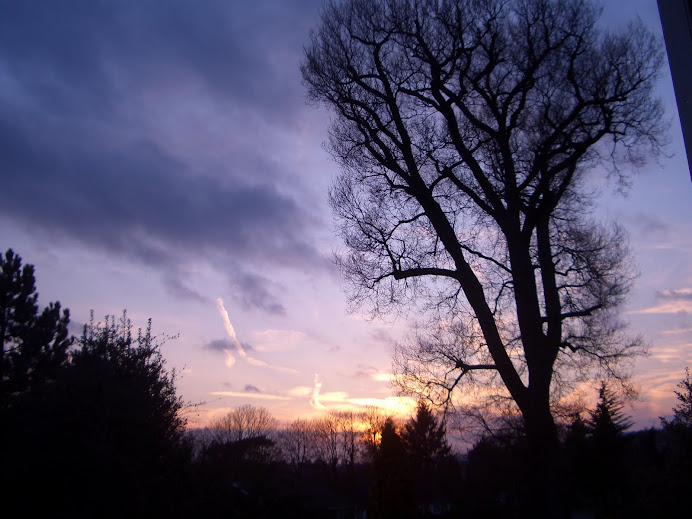
Sunset

Sunset
with vapor trails

Followers

Total Pageviews